
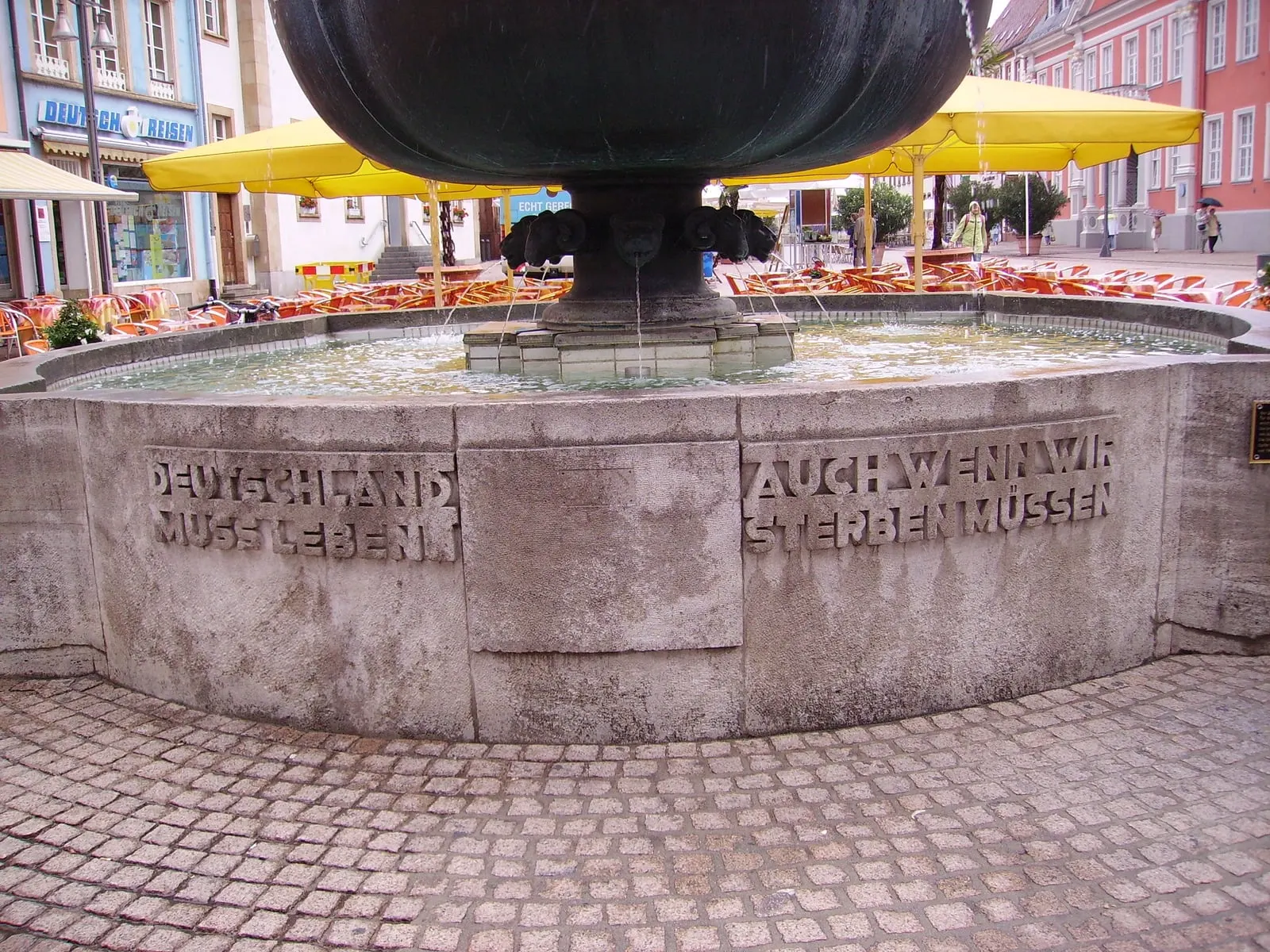
Several memorials in Speyer commemorate the victims of the great wars of the 19th and 20th centuries. The selection, design and understanding of these places of remembrance have changed across the generations: from a triumphal victory gesture to one of warning. This change reflects a German debate that is not yet concluded.
The war memorial of 1870/71
The memorial to the Franco-Prussian War of 1870/71 was erected as a symbol of victory. The originally planned Germania figure with a victory wreath was to rise on a tall pedestal, similar to the Bavaria in Munich. The memorial was financed by a broad fundraising movement of veterans’ associations, lotteries and the general population.
The message was unambiguous: pride in victory, heroization of the fallen soldiers, association with the new German Empire. Today such a memorial can no longer be felt directly; it is a witness to a different culture of remembrance.
First World War: monuments of mourning
After the First World War the tone shifted. Instead of triumph, grief and loss took center stage. Carl Egler, an important sculptor of the Weimar era, created several memorials in this new language. Instead of heroic poses, his sculpture shows the burden, the suffering, sometimes the quiet dignity of the fallen.
Several First World War memorials can be found in and around Speyer, often at cemeteries or central squares - including in Adenauer Park and along the Old Town’s axes. These places remain focal points of remembrance on Germany’s national day of mourning.
Second World War: remembrance transformed
After the Second World War, dealing with war memorials became even more complex. Heroic staging had become impossible after the experience of the Nazi regime. Remembrance now had to include the civilian victims, Germany’s share of responsibility and the destruction itself.
Memorials were deliberately kept plain. A mourning figure, a cross, a plaque with names - that sufficed to set the tone of warning. In Speyer, such memorials can be found at cemeteries and churches.
Soviet memorials
The post-war period also produced Soviet memorials commemorating fallen soldiers of the Red Army. Their design uses classic Soviet symbolism: the red star, Cyrillic inscriptions, sometimes hammer and sickle. Today these memorials are understood as part of a many-layered landscape of remembrance, though they are occasionally the subject of critical debate.
National Socialist legacies
From the Nazi era there are built legacies whose handling is sensitive. Bunker complexes such as the Augustinerhof high-rise bunker, barracks and individual monuments from the 1930s remain present in the cityscape - including in the historic surroundings of the Technik Museum, which was established on the site of a former aircraft factory. The question of whether such structures should be preserved or removed has not been conclusively answered.
A common argument for preservation: such places visibly warn of the Nazi era. Against preservation: they can continue to resonate with admirers. In Speyer, as in many German cities, the debate keeps being reopened.
Modern memorials
Newer memorials in Speyer speak a different language: more abstract, more participatory, more questioning. Contemporary artists work with unusual materials and forms. Some memorials offer space for individual mourning as well as public remembrance. They invite reflection instead of fixing a single reading.
A culture of remembrance in flux
Whoever walks through Speyer and views the war memorials in context reads off a history of German remembrance culture: from the triumphal style of the Empire through the mourning sculpture of the Weimar Republic and the awkward silence of the early Federal Republic to the open, often painful debates of the present. Memorials are never just stones; they are political statements - part of the city’s many-layered cultural heritage, which the Thirty Years’ War and later conflicts also shaped.
Frequently asked questions
What is the best-known war memorial in Speyer?
The war memorial of 1870/71, a symbol of victory in the Franco-Prussian War. Today it is mainly of interest as a historical document of the imperial era.
Who was Carl Egler?
An important sculptor of the Weimar era who created several memorials for the victims of the First World War, including in the Speyer region.
What are Soviet memorials?
Post-war monuments commemorating fallen soldiers of the Red Army. They use classic Soviet symbolism such as the red star and Cyrillic script.
How are Nazi-era structures dealt with?
The debate is not settled. Arguments for preservation as a warning stand against arguments for removal. Several such structures still exist in Speyer.
What distinguishes modern memorials?
They are more abstract, often participatory, questioning rather than prescriptive. They allow individual readings and open space for both personal and public mourning.
* Tours & tickets from GetYourGuide. If you book through the markers we earn a commission, at no extra cost to you.