
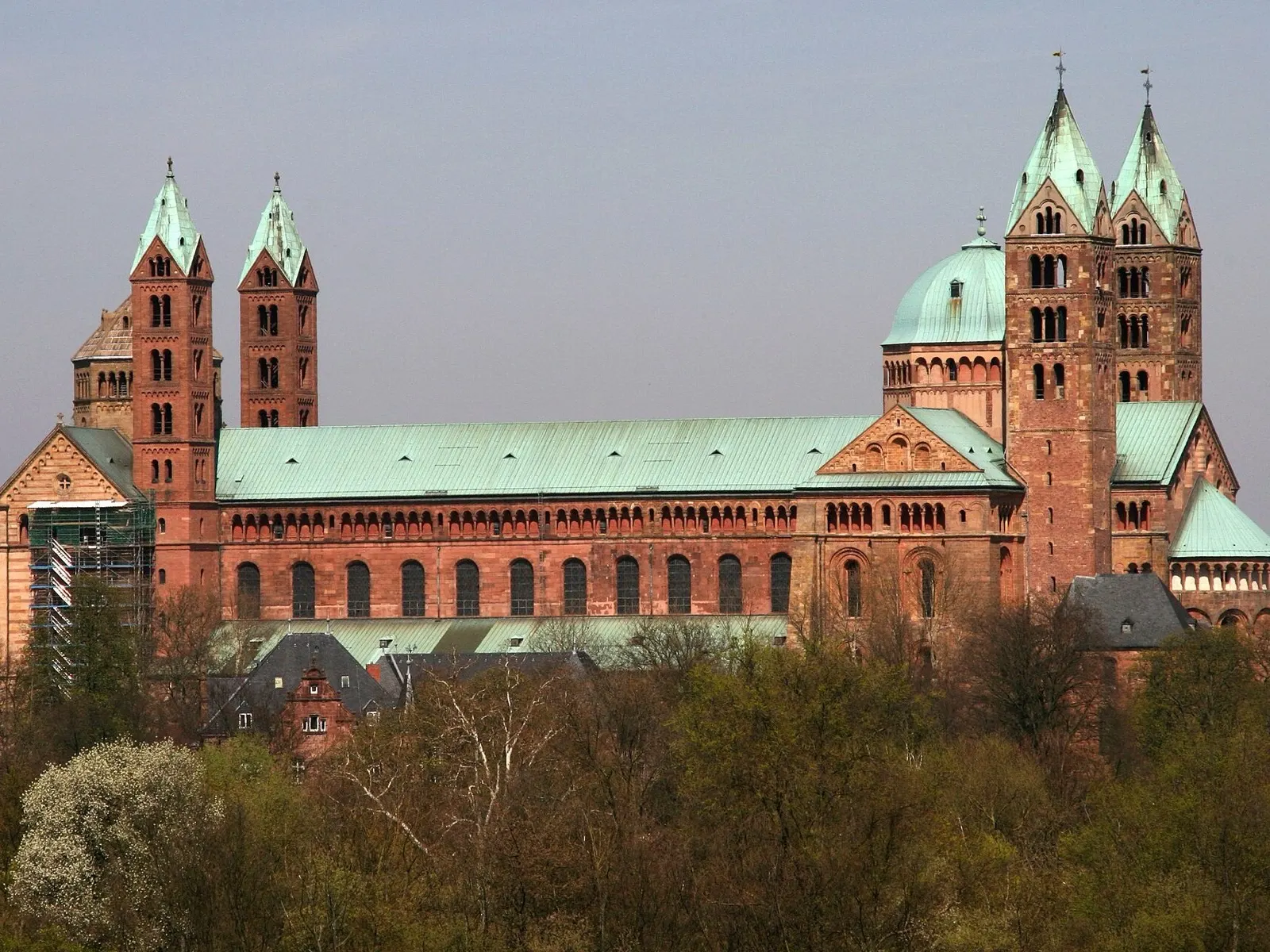
Speyer holds two UNESCO World Heritage titles. The Imperial Cathedral was inscribed in 1981; the ShUM sites (Speyer-Worms-Mainz) followed in 2021. Both document central chapters of European cultural history: High Romanesque architecture and medieval Ashkenazi Judaism.
Speyer Cathedral: a masterpiece of the Romanesque
The Imperial Cathedral is the largest surviving Romanesque church in the world. At over 130 meters in length and with four mighty towers, it has dominated the cityscape since the 11th century.
Architectural features:
- The largest hall crypt of the Romanesque era, consecrated in 1041
- Massive round arches and a clear geometric structure
- Ornamentation partly by Italian sculptors
The cathedral served as the burial place of the four Salian emperors and influenced the design of Romanesque churches across Germany and beyond. After the destruction of Cluny, it is considered the most significant surviving building of its era in Europe.
In 1981 UNESCO recognized above all criterion (ii): the cathedral represents a major interchange of human values in the development of architecture and monumental sculpture. The cathedral’s restoration history has also decisively shaped German monument preservation.
The ShUM sites
ShUM is the Hebrew acronym for Speyer, Worms and Mainz - the three cities of the most important Ashkenazi Jewish communities of the High Middle Ages. Their joint World Heritage inscription in 2021 honors these communities’ unique significance for the development of European Judaism.
In Speyer, the World Heritage property comprises:
- The former Jewish quarter with the Jewish Courtyard
- The remains of the synagogue built in 1104
- The women’s shul, a prayer room for women
- Archaeological remains of the yeshiva (Talmud school)
- The still intact underground mikvah (ritual bath) from the early 12th century
The Speyer mikvah is one of the oldest surviving Jewish ritual baths in Europe and an architectural marvel. From the courtyard, stairs lead deep down to the groundwater level.
World Heritage Day
The annual UNESCO World Heritage Day (first Sunday in June) is an important date in Speyer. Both the cathedral and the Jewish Courtyard offer special tours and events on this day.
The local community plays a central role: associations, schools and churches take part in the program. Workshops for children and young people convey the meaning of the World Heritage and an awareness of its protection.
Outstanding Universal Value (OUV)
For inscription on the World Heritage List, UNESCO requires Outstanding Universal Value (OUV), assessed against ten criteria - plus authenticity (historical genuineness) and integrity (wholeness).
Speyer meets these requirements twice over: the cathedral for Romanesque architecture, the ShUM sites for Jewish cultural history. Both inscriptions come with clear conservation obligations, which require continuous restoration and protection.
Impact on the region
The World Heritage sites have tangible effects:
- Tourism: Hundreds of thousands visit the city each year. Gastronomy, hotels and retail benefit.
- Education: Schools and universities use the sites for excursions and research projects.
- Identity: Speyer sees itself as a World Heritage city. That shapes its marketing and self-image.
Challenges
Maintaining two World Heritage sites is demanding. Authenticity and integrity must be preserved while balancing tourism and protection. Crowds can strain the sites, which is why there is visitor management and continuous restoration - if you are planning a relaxed World Heritage visit, the 2 Days in Speyer travel plan offers a sensible route.
Frequently asked questions
When did the cathedral become a World Heritage Site?
In 1981, as a principal work of Romanesque architecture in Germany.
What are the ShUM sites?
ShUM stands for Speyer, Worms and Mainz, the three most important Ashkenazi Jewish communities of the High Middle Ages. Their sites were jointly inscribed as UNESCO World Heritage in 2021.
Which Jewish buildings survive in Speyer?
The Jewish Courtyard with the synagogue remains, the women’s shul, the yeshiva remains and the underground mikvah from the early 12th century.
What is World Heritage Day?
An annual action day on the first Sunday in June. The cathedral and the Jewish Courtyard offer special tours, often with workshops for children.
What does OUV mean?
Outstanding Universal Value - the exceptional significance of a World Heritage site, assessed against ten UNESCO criteria.
* Tours & tickets from GetYourGuide. If you book through the markers we earn a commission, at no extra cost to you.