
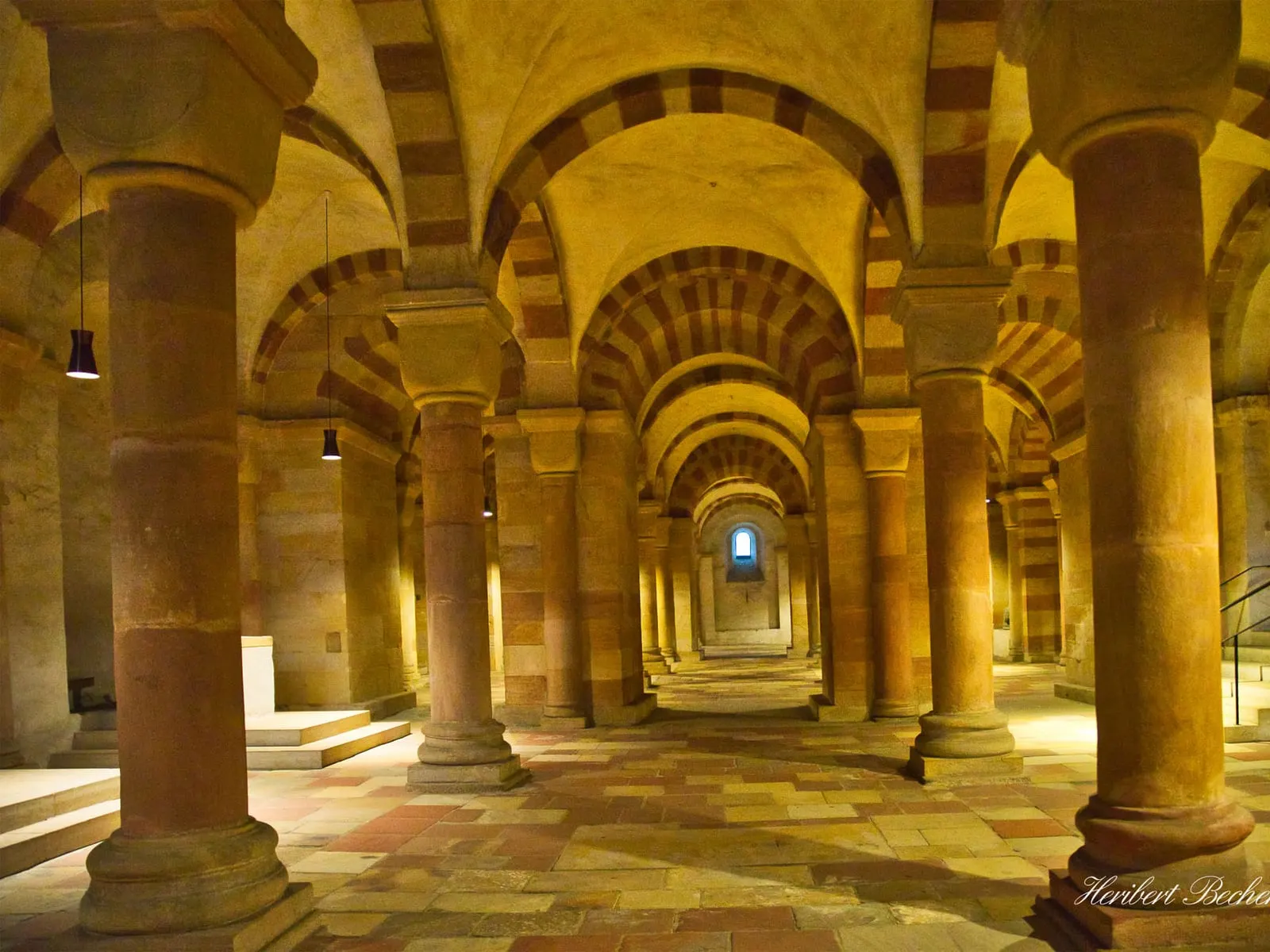
The Salians were the ruling dynasty of the Holy Roman Empire between 1024 and 1125. Their traces in Speyer are so dense that the city is rightly remembered as their capital. Four emperors of this dynasty lie buried in the crypt of the Imperial Cathedral - a building that would not exist without them.
Founding of the dynasty
The Salian family came from the Rhine-Moselle region and rose to supreme power in the Empire in the early 11th century. Conrad II, elected king in 1024 and crowned emperor in 1027, made Speyer one of his principal residences. That choice shaped the city for centuries and laid the foundation for its rank within the Empire.
Four emperors, one cathedral
Under Conrad II, construction of the cathedral began around 1025, with the explicit intention of building the largest church in the Western world.
- Conrad II (1024-1039) laid the foundation stone and gave the cathedral its monumental scale.
- Henry III (1039-1056) continued the construction and strengthened Speyer’s position in the Empire.
- Henry IV (1056-1106) completed the original building and had the cathedral enlarged. His conflict with Pope Gregory VII (the Investiture Controversy, the Walk to Canossa) made him one of the most dramatic figures of the Middle Ages.
- Henry V (1106-1125) was the last Salian emperor. With his death, the dynasty ended without a male heir.
All four lie buried in the cathedral crypt, joined by further kings and emperors of later dynasties who found their final rest here in the Salian tradition.
The cathedral as a Salian manifesto
The cathedral is not just a building but a political statement. Its size (over 130 meters in length), the massive round arches, the monumental towers and the clear geometric structure expressed the Salian claim to lead the Empire in a manner pleasing to God - and to manifest that claim in stone. The cathedral’s High Romanesque architecture became the model for numerous churches across the Empire.
The crypt, consecrated in 1041 under Henry III, is the largest hall crypt of the Romanesque era. It combines its sacred function with that of a burial place, making the cathedral the dynastic memoria of the Salians.
Speyer as a center of the Empire
In the Middle Ages, Speyer repeatedly hosted imperial diets and court assemblies. From 1527, the Imperial Chamber Court sat here - a central political factor in the age of the Reformation. Chroniclers of the 12th century called the city Metropolis Germaniae or Caput Sedis - the head of the Empire. That perception was rooted in the Salian past and in the cathedral as a symbol of imperial power.
The bishops of Speyer
Alongside the emperor, the bishop of Speyer was a significant power. He held both spiritual and secular responsibilities and helped shape city politics. The relationship between the bishops and the Salians was changeable: sometimes the two cooperated, sometimes they clashed - for instance over the appointment of church offices. The Investiture Controversy under Henry IV was also a dispute over these roles.
Civic liberties
Under Salian rule, the citizens of Speyer received significant liberties and privileges. The Speyer charter of liberties is one of the early examples of civic self-determination in German cities. These rights laid the groundwork for the later status as a free imperial city and fostered trade, crafts and cultural life.
The legacy today
The Salians still shape Speyer. The cathedral as a UNESCO World Heritage Site (since 1981) is the most visible legacy. Add to that monuments, exhibitions, regular scholarly conferences and the city’s self-image as a place of imperial history. The crypt draws numerous visitors every year who want to stand before the sarcophagi of the four emperors - where, in the Middle Ages, the Empire itself lay symbolically buried.
Frequently asked questions
Who were the Salians?
A ruling dynasty of the Holy Roman Empire between 1024 and 1125, with four emperors: Conrad II, Henry III, Henry IV and Henry V.
Why is Speyer linked to the Salians?
Conrad II made Speyer one of his principal residences and began the cathedral as a burial place, and all four Salian emperors are buried there.
Who is buried in Speyer Cathedral?
Conrad II, Henry III, Henry IV, Henry V, as well as further kings and emperors of later dynasties, along with bishops of Speyer.
What was the Investiture Controversy?
The conflict between Henry IV and Pope Gregory VII over the right to appoint bishops. It culminated in Henry’s legendary Walk to Canossa in 1077.
Why is the cathedral considered a Salian building?
It was begun under Conrad II, completed and enlarged under the Henrys, and served the dynasty as its burial place. Its size, style and symbolism express the Salian self-image.
* Tours & tickets from GetYourGuide. If you book through the markers we earn a commission, at no extra cost to you.