
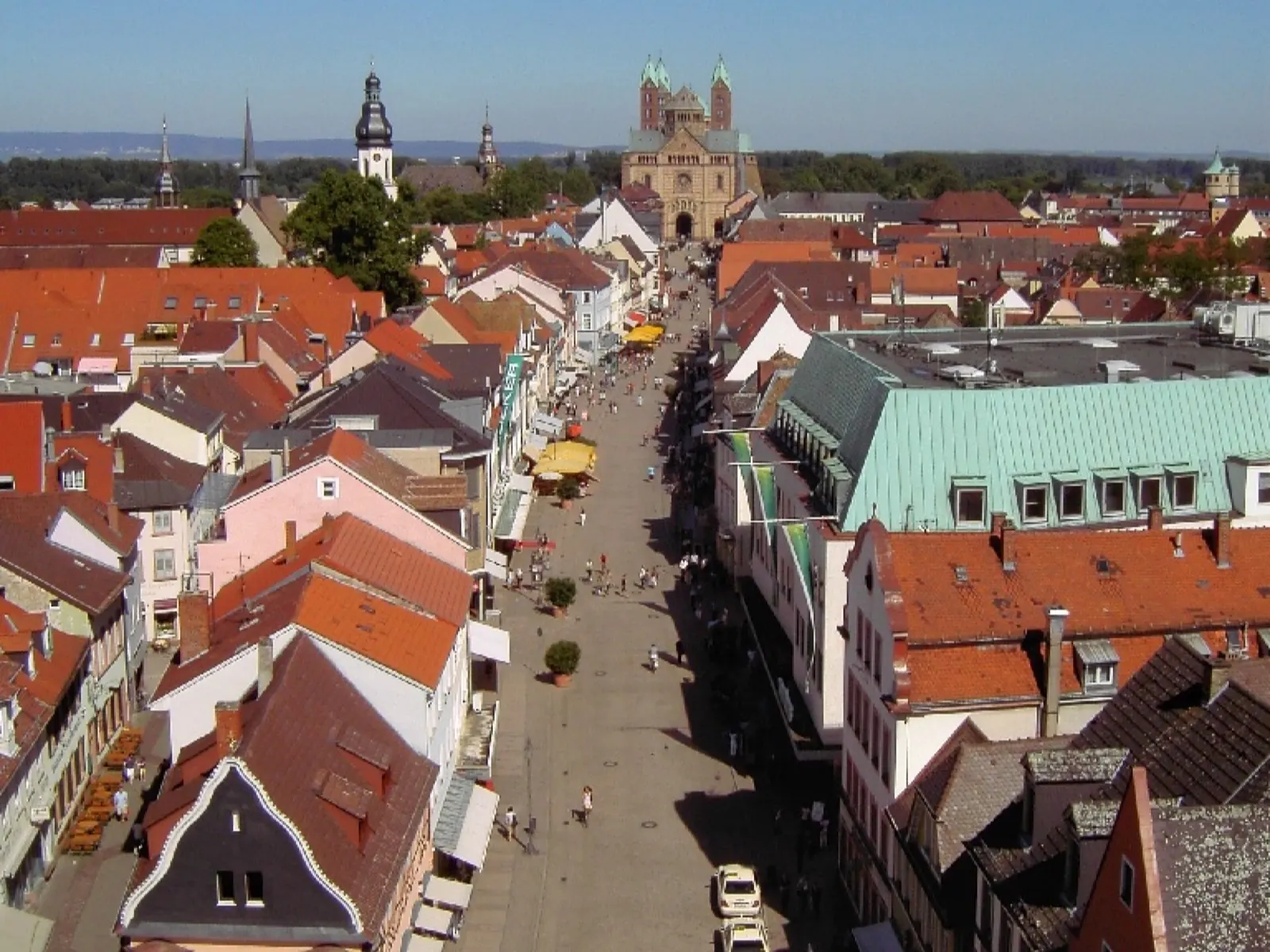
Speyer’s building history spans an arc from the High Romanesque architecture of the cathedral through the Baroque reconstruction after 1689 to the historicist Memorial Church and the modern buildings at the Rhine harbor. Walking through the city, you read the centuries side by side.
The Romanesque in Speyer
The Romanesque is the first independent European artistic era after the end of antiquity. Its hallmarks are round arches, massive walls, block-like capitals and cube motifs. The introduction of stone vaulting allowed wide, fireproof interiors for the first time since the Roman era.
Speyer Cathedral, built in the 11th century under the Salians, is considered the pinnacle of German Romanesque. At over 130 meters in length, it is the largest surviving Romanesque church in the world. Its crypt of 1041 is the largest hall crypt of the era. The cathedral shaped the style of numerous churches in Rhineland-Palatinate and beyond.
Gothic
The transition to the Gothic brought pointed arches, ribbed vaults and buttresses. These innovations allowed taller, light-flooded buildings. Speyer is dominated by the Romanesque, but Gothic elements were added:
- On the cathedral itself, Gothic chapels and the “Little Paradise” on the north side can be seen.
- Holy Trinity Church shows Gothic vaults and windows.
The renowned Gothic master builder Anton Pilgram (St. Stephen’s Cathedral in Vienna) also left traces in the southern German region and influenced the style here.
Renaissance
The Renaissance brought a return to ancient forms: clear lines, symmetry, proportion, columns and pilasters. Buildings of this era are rarely preserved in Speyer, because the fire of 1689 destroyed so much. But the Old Town Hall and parts of Holy Trinity Church show influences of Italian Renaissance architecture, which reached the Palatinate through the cloth trade and the mobility of artists.
Baroque
Baroque architecture shapes today’s cityscape more than any other era, because Speyer was rebuilt in Baroque forms after the fire of 1689. Characteristic are:
- Curved facades and dynamic lines
- Richly decorated interiors with stucco and marble
- Prestigious townhouses and church buildings
A major work is the westwork of the cathedral, reconstructed in Baroque form after 1689 by Franz Ignaz Michael Neumann. In the 19th century it was partly re-Romanized - a telling example of the era’s ambivalent approach to monument care. Holy Trinity Church is Speyer’s most important Protestant Baroque building, with elaborate ceiling paintings and a Baroque altar ensemble.
Historicism and modernity
The 19th century brought the Memorial Church of the Protestation (consecrated 1904) in neo-Gothic style. It commemorates the Protestation of 1529 and has one of the tallest church spires in the Palatinate. The striking Historical Museum of the Palatinate by the cathedral garden and design elements in the neighboring Adenauer Park also date from this building phase.
The 20th century modernized Speyer rather cautiously. Modern forms can be found at the Rhine harbor and in the newer districts, but the Old Town’s appearance deliberately remained historic.
Architecture as a statement
Speyer’s buildings were always more than utilitarian architecture. The cathedral was a manifestation of imperial power, the Memorial Church a confessional statement, the Altpörtel a sign of civic self-confidence. In Speyer, architecture has told history - and it still does.
Frequently asked questions
What is the most important Romanesque building in Speyer?
The Imperial Cathedral: the largest surviving Romanesque church in the world and a UNESCO World Heritage Site since 1981.
Are there Gothic buildings in Speyer too?
Yes - Gothic elements can be found on the cathedral (chapels, the “Little Paradise”) and on Holy Trinity Church. Purely Gothic buildings are rare.
Why does the Baroque dominate the Old Town?
The city fire of 1689 destroyed most of the medieval fabric. Reconstruction proceeded through the 18th century in Baroque forms.
What is the Memorial Church?
A neo-Gothic church consecrated in 1904 that commemorates the Protestation of Speyer of 1529. It is one of the city’s most important historicist buildings.
What role does monument preservation play?
Speyer is a classic example of the development of monument preservation in Germany. The restorations of the cathedral since the 19th century have influenced professional opinion nationwide.
* Tours & tickets from GetYourGuide. If you book through the markers we earn a commission, at no extra cost to you.